The Things That Matter: What Seven Classic Novels Have to Say About the Stages of Life by Edward Mendelson
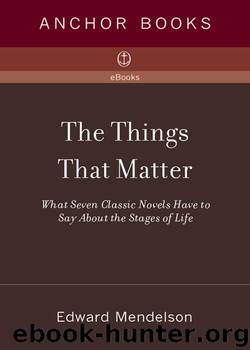
Author:Edward Mendelson [Mendelson, Edward]
Language: eng
Format: epub
ISBN: 9780307491848
Publisher: Knopf Doubleday Publishing Group
Published: 2008-11-26T00:00:00+00:00
“But you leave out the poems,” Dorothea replies. “I think they are wanted to complete the poet.” Dorothea adds that she understands Will’s metaphor of knowledge passing into feeling, “for that seems to me just what I experience,” but she says everywhere else that she lacks the knowledge she needs in order to quicken her feelings. And she notices that Will, by leaving out the poems, leaves out anything that might be made out of those sounding chords of emotion and bright flashes of feeling—chords and flashes that occur, as he says, in “fits only,” not in anything as extended and organized as a poem, not in anything that might sustain a marriage or a life.
In the world of Jane Eyre, nature and spirit gave guidance to anyone in perplexity who asked for guidance. In the world of Middlemarch—almost until the last minute—all must find their way alone. Will Ladislaw and Dorothea Brooke are the hero and heroine of a uniquely modern kind of quest. Unlike the ancient heroes who know from the start what they are looking for, who set out on their journey with a clear sense that they intend to return to Ithaca and Penelope or steal the Golden Fleece or find the Holy Grail, George Eliot’s modern wanderers do not know what they are looking for, and they must search for the knowledge that could tell them what they ought to want. In George Eliot’s next and final novel, Daniel Deronda, the hero attains that kind of knowledge when he learns that he is a Jew, and he goes off to Palestine to find his epos in service to a social faith—as if he were the St. Theresa of the “Prelude” to Middle-march reborn in a different sex, century, and religion. But no epos, no epic purpose or grandeur, is possible for the questers in Middlemarch, and George Eliot ends Dorothea’s love story with her discovery of a knowledge that is as much a knowledge of her own heart as of any epic purpose. The lightning bolt that throws Dorothea and Will together does not have the power to keep them together, and when he prepares to leave a few minutes later, Dorothea brings him back forever by saying, “Oh, I cannot bear it—my heart will break.”
Download
This site does not store any files on its server. We only index and link to content provided by other sites. Please contact the content providers to delete copyright contents if any and email us, we'll remove relevant links or contents immediately.
4 3 2 1: A Novel by Paul Auster(12392)
The handmaid's tale by Margaret Atwood(7763)
Giovanni's Room by James Baldwin(7346)
Asking the Right Questions: A Guide to Critical Thinking by M. Neil Browne & Stuart M. Keeley(5775)
Big Magic: Creative Living Beyond Fear by Elizabeth Gilbert(5771)
Ego Is the Enemy by Ryan Holiday(5447)
The Body: A Guide for Occupants by Bill Bryson(5096)
On Writing A Memoir of the Craft by Stephen King(4943)
Ken Follett - World without end by Ken Follett(4731)
Adulting by Kelly Williams Brown(4574)
Bluets by Maggie Nelson(4556)
Eat That Frog! by Brian Tracy(4540)
Guilty Pleasures by Laurell K Hamilton(4448)
The Poetry of Pablo Neruda by Pablo Neruda(4106)
Alive: The Story of the Andes Survivors by Piers Paul Read(4031)
White Noise - A Novel by Don DeLillo(4009)
Fingerprints of the Gods by Graham Hancock(4004)
The Book of Joy by Dalai Lama(3986)
The Bookshop by Penelope Fitzgerald(3853)
